
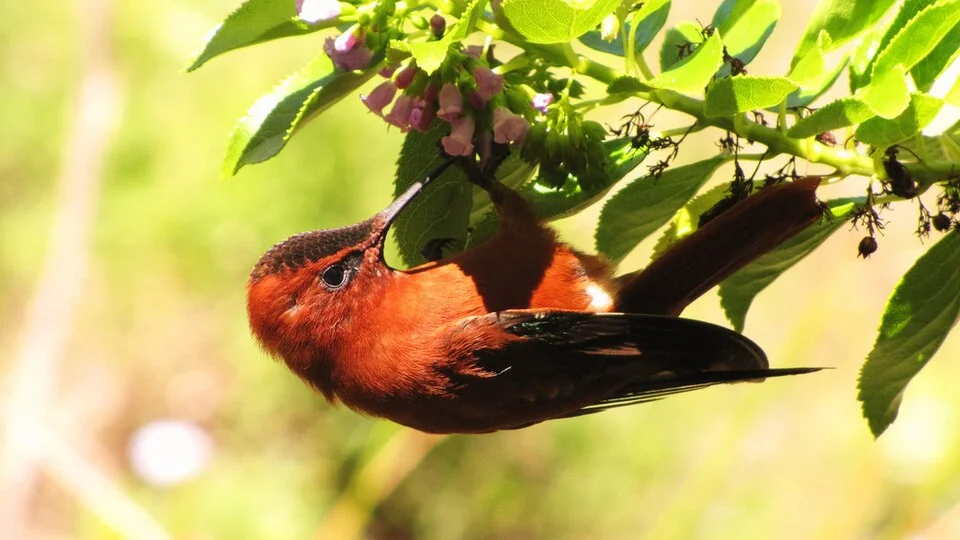
The Juan Fernández firecrown: a critically endangered hummingbird
Endemic to Robinson Crusoe and critically endangered: depending on the source, some 490 to 3,500 remain. Its biggest threat: bramble and maqui invading its forest.
On Robinson Crusoe Island lives one of the most singular and threatened hummingbirds on the planet: the Juan Fernández firecrown (Sephanoides fernandensis), known locally as the picaflor rojo. The male, with its intense cinnamon-orange plumage and iridescent crown, is unmistakable.
The female, bluish-green above and white with dark spots below, looks so different that in the 19th century the two sexes were described as separate species, until a nest was found with one adult of each sex.
An absolute endemic
This species exists nowhere else on Earth: today it lives only in the native forest of Robinson Crusoe. It nests mainly in the luma tree (Nothomyrcia fernandeziana, formerly Myrceugenia fernandeziana), where a 2011 study found more than three quarters of its nests, and feeds on the nectar of the juan bueno (Rhaphithamnus venustus) and of Sonchus brassicifolius, an endemic plant that Chile classifies as Endangered and Rare (2008); the IUCN had listed it as Critically Endangered in 1998.
Because of that dependence, the firecrown is a good indicator of the island forest's health: when the native forest shrinks, so does the firecrown.
The numbers of decline
In its 2020 assessment for the IUCN Red List, BirdLife International estimates the population at 1,500 to 3,500 mature adults, and the species is classified as Critically Endangered. Other counts give different figures because they use different methods: Island Conservation estimated a population of 2,539 ± 947 between 2011 and 2014, and CONAF's latest census, carried out in the southern winter of 2020 (June and July), counted some 490 individuals, according to the RECOGE recovery plan of Chile's Ministry of the Environment.
The main threat is the invasion of exotic plants, above all bramble (Rubus ulmifolius) and maqui (Aristotelia chilensis), which replace the native forest where the firecrown nests and feeds. Added to this are predation of nests and adults by introduced rats, cats and coatis, and competition with the more abundant green-backed firecrown (Sephanoides sephaniodes).
Conservation in progress
Since 2004, an alliance of The Hummingbird Society, American Bird Conservancy and Oikonos has been working on the island: controlling invasive plants, replanting native species, controlling predators and running pet sterilization campaigns. Oikonos has trained more than 25 islanders in invasive plant control and restored more than 12 hectares of native forest.
Even so, the scale of the problem outpaces these efforts: according to a 2023 study, bramble, maqui and murtilla already cover about 15% of the island. Without sustained institutional support, the firecrown's future remains uncertain.
If you visit Robinson Crusoe, you can help with simple gestures: don't move plants or seeds around, and stay on the National Park trails. Every visitor who understands the value of this hummingbird joins in its protection.
Experience it on the island
- Seafront cabins in El Palillo
Seven cabins just metres from the beach, facing Cumberland Bay: your base for exploring the island.
- Robinson Crusoe Island travel guide
The national park and its rules, what to pack, connectivity and practical tips.
Keep reading
- Flora Bramble and maqui: the invaders smothering the native forest
Bramble arrived in 1927 and, together with maqui, is invading the forest of Robinson Crusoe, home to plants found nowhere else in the world.
- Flora Tree ferns: the high-elevation forest of Robinson Crusoe Island
Thyrsopteris elegans, the last survivor of its family, and Dicksonia berteroana shape the high-elevation forest, one of the island's most fragile habitats.
- Heritage Biosphere Reserve: what it protects and what's missing
Much of the archipelago is a National Park and a UNESCO Biosphere Reserve, with endemic flora and fauna. On land, invasive plants keep spreading.
- Marine Wildlife Juan Fernández fur seal: from near extinction to over 180,000
Hunted almost to extinction and rediscovered in 1965, it numbered some 183,000 animals in the 2021 census: one of the great recoveries in the Pacific.