
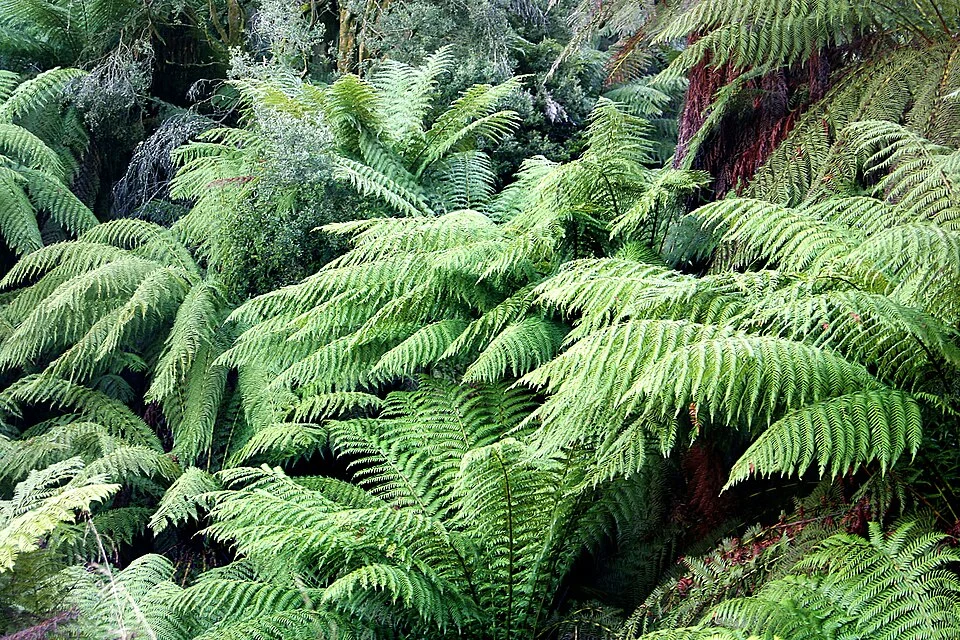
Tree ferns: the high-elevation forest of Robinson Crusoe Island
Thyrsopteris elegans, the last survivor of its family, and Dicksonia berteroana shape the high-elevation forest, one of the island's most fragile habitats.
On the humid slopes of Robinson Crusoe, from about 300 to 400 meters above sea level, the landscape changes. The montane forest appears, with endemic trees such as the Juan Fernández canelo (Drimys confertifolia) and an understory of tree ferns with thick trunks and fronds up to 3 meters long that filter the light into deep shades of green.
Thyrsopteris elegans, with no close living relatives
Thyrsopteris elegans is the only living species in its family, Thyrsopteridaceae. Its genus has fossils about 99 million years old, from the Cretaceous period. It is a tree fern up to 2.5 meters tall, with a thick trunk up to 20 cm in diameter.
It grows only in the archipelago, on Robinson Crusoe and Alejandro Selkirk. On Robinson Crusoe it lives in the humid mountain forests from 400 meters up, between Puerto Francés and the summit of El Yunque. On Selkirk, the tree fern forest is formed by another species, Dicksonia externa. Chile's Ministry of the Environment, which estimates fewer than 2,000 individuals across both islands, classifies Thyrsopteris elegans as Endangered.
Dicksonia berteroana and the high-elevation community
It shares the forest with Dicksonia berteroana, another endemic tree fern found only on Robinson Crusoe. It can reach 6 meters in height, grows between 300 and 700 meters and is also classified as Endangered: there are an estimated 2,000-plus adults, which never form large stands and regenerate poorly in the wild.
Beneath these ferns a humid, shady microclimate forms, where mosses, lichens and small ferns thrive on trunks and branches.
An ecosystem under pressure
Although the upper zone is less invaded than the lowlands, it is not safe. Chile's Ministry of the Environment identifies bramble, maqui and murtilla, all clearly expanding, as the main threat to Thyrsopteris elegans. Introduced goats and rabbits have left their mark on the understory, and fires have damaged the island's native forest.
These forests lie within the Archipiélago de Juan Fernández National Park, managed by CONAF. If you want to see them, ask CONAF about the authorized trails and access conditions, stay on them, and check that your clothes and shoes aren't carrying seeds: that way you help avoid spreading invasive species.
Experience it on the island
- Seafront cabins in El Palillo
Seven cabins just metres from the beach, facing Cumberland Bay: your base for exploring the island.
- Robinson Crusoe Island travel guide
The national park and its rules, what to pack, connectivity and practical tips.
Keep reading
- Wildlife The Juan Fernández firecrown: a critically endangered hummingbird
Endemic to Robinson Crusoe and critically endangered: depending on the source, some 490 to 3,500 remain. Its biggest threat: bramble and maqui invading its forest.
- Flora Bramble and maqui: the invaders smothering the native forest
Bramble arrived in 1927 and, together with maqui, is invading the forest of Robinson Crusoe, home to plants found nowhere else in the world.
- Heritage Biosphere Reserve: what it protects and what's missing
Much of the archipelago is a National Park and a UNESCO Biosphere Reserve, with endemic flora and fauna. On land, invasive plants keep spreading.
- Marine Wildlife Juan Fernández fur seal: from near extinction to over 180,000
Hunted almost to extinction and rediscovered in 1965, it numbered some 183,000 animals in the 2021 census: one of the great recoveries in the Pacific.