
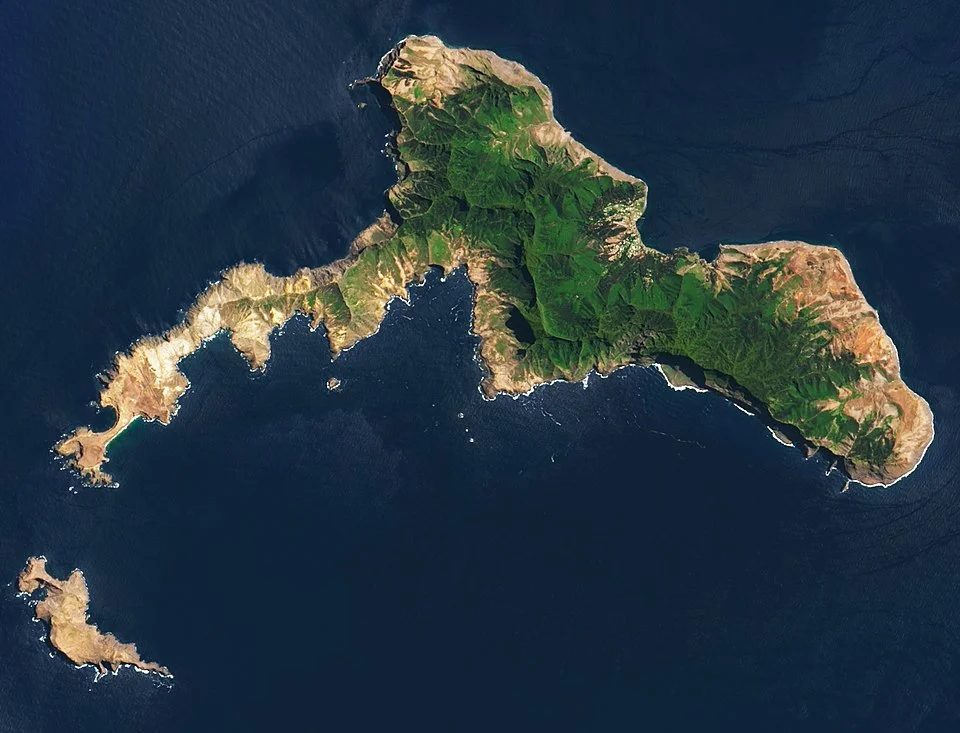
Bramble and maqui: the invaders smothering the native forest
Bramble arrived in 1927 and, together with maqui, is invading the forest of Robinson Crusoe, home to plants found nowhere else in the world.
The Juan Fernández Archipelago is home to one of the most singular floras on the planet: according to UNESCO, 131 plant species — 62% of its native vascular flora — are endemic, meaning they exist nowhere else; other counts put the share as high as 65%. That richness now faces its greatest threat: introduced plants that are advancing on the native forest and displacing the original species.
The invaders
Bramble (Rubus ulmifolius), native to Europe, was recorded on the island in 1927 and became highly aggressive: it forms impenetrable thickets that block the light and prevent the forest from regenerating. Maqui (Aristotelia chilensis), a shrub from mainland Chile, grows fast and its fruits are spread by birds such as the Austral thrush (Turdus falcklandii), allowing it to colonize clearings and ravines.
A 2023 study led by botanist Tod Stuessy calculates that bramble, maqui and murtilla (Ugni molinae) already cover 15% of Robinson Crusoe's surface, and bramble alone 7%. And the problem goes beyond those three: according to the same study, around half of the flora growing on the islands today is of exotic origin.
What is being lost
The affected species include genera found only in the archipelago, such as Dendroseris (the Juan Fernández cabbage trees, which many botanists now include in Sonchus), Robinsonia and Rhetinodendron. Today, more than three quarters of the native and endemic vascular species are threatened or endangered, and some have populations so small that any further impact could wipe them out.
The island has already lost the Juan Fernández sandalwood (Santalum fernandezianum): botanist Carl Skottsberg saw the last tree in 1908, and when he returned in 1916 it was gone. On Alejandro Selkirk, where some 4,000 goats are the main problem, Dendroseris gigantea went extinct in the wild in 2014 and now survives only in cultivation, thanks to rescued seeds. As the forest shrinks, so does the wildlife that depends on it, such as the Juan Fernández firecrown, which nests and feeds on native species.
Active restoration
Between 2015 and 2018, a project coordinated by CABI (Centre for Agriculture and Bioscience International) with INIA, Oikonos, the Chilean Ministry of the Environment and CONAF worked on two fronts: removing invasive plants and propagating native species for replanting. Periodic eradication of bramble and maqui patches, especially around San Juan Bautista, has also helped slow their spread.
Other tools are being explored too: in 2019, Chilean researchers published an evaluation of a rust fungus (Phragmidium violaceum) as a possible biological control for bramble on the island.
The scale of the problem is enormous, but the knowledge exists. What is missing is time, funding and sustained commitment: the flora of Juan Fernández has nowhere else to go.
Experience it on the island
- Robinson Crusoe Island travel guide
The national park and its rules, what to pack, connectivity and practical tips.
- Seafront cabins in El Palillo
Seven cabins just metres from the beach, facing Cumberland Bay: your base for exploring the island.
Keep reading
- Flora Tree ferns: the high-elevation forest of Robinson Crusoe Island
Thyrsopteris elegans, the last survivor of its family, and Dicksonia berteroana shape the high-elevation forest, one of the island's most fragile habitats.
- Wildlife The Juan Fernández firecrown: a critically endangered hummingbird
Endemic to Robinson Crusoe and critically endangered: depending on the source, some 490 to 3,500 remain. Its biggest threat: bramble and maqui invading its forest.
- Heritage Biosphere Reserve: what it protects and what's missing
Much of the archipelago is a National Park and a UNESCO Biosphere Reserve, with endemic flora and fauna. On land, invasive plants keep spreading.
- Artisanal Fishing Jasus frontalis: the clawless lobster of Juan Fernández
Found only around Juan Fernández and the Desventuradas, it is caught with traps, a closed season, a minimum size and a traditional system of family “marcas”.