
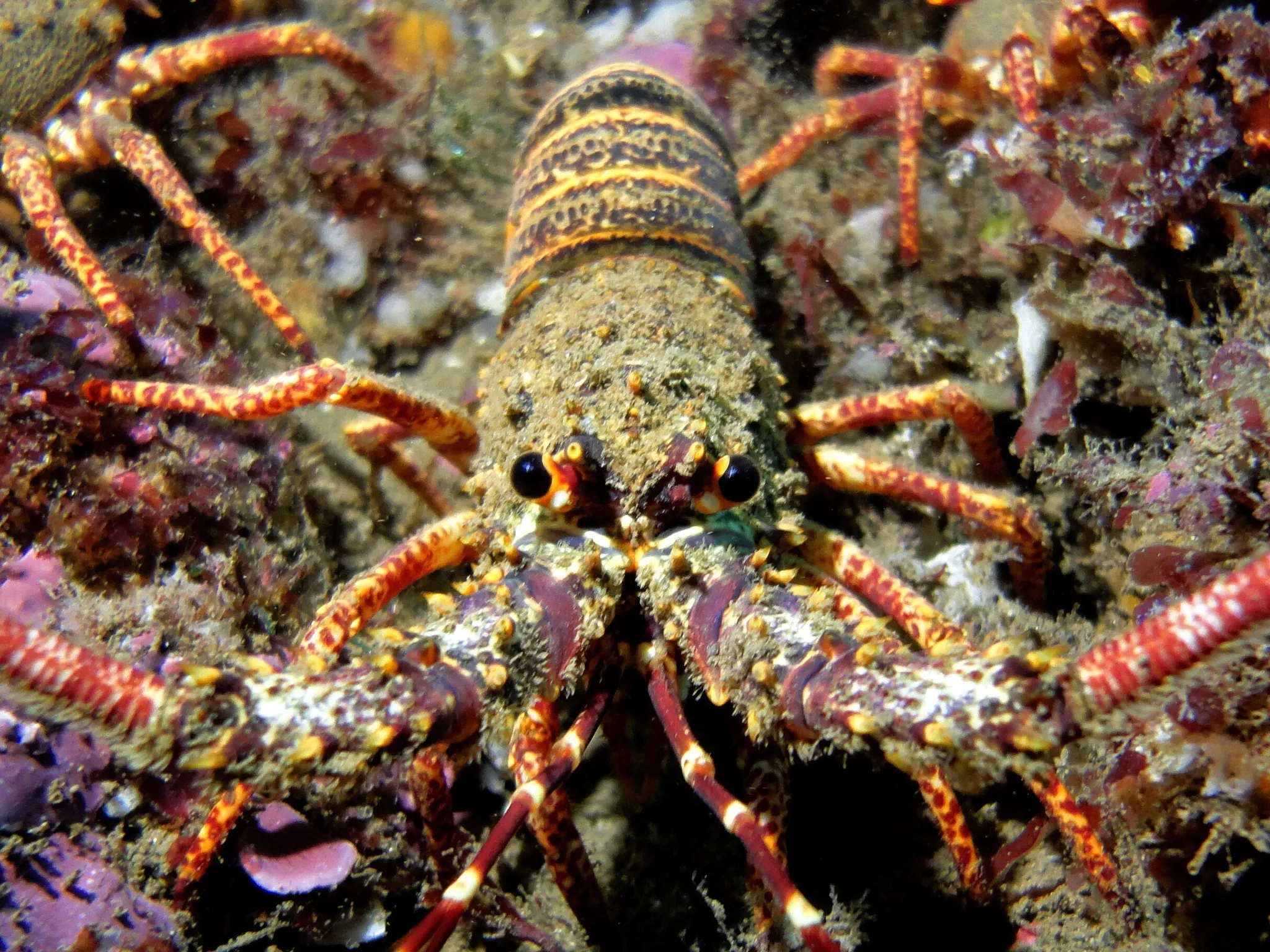
Jasus frontalis: the clawless lobster of Juan Fernández
Found only around Juan Fernández and the Desventuradas, it is caught with traps, a closed season, a minimum size and a traditional system of family “marcas”.
On the rocky seabed of the Juan Fernández Archipelago lives the Juan Fernández rock lobster (Jasus frontalis), the island's most emblematic fishery resource. Unlike North Atlantic lobsters, it has no claws: its long, spiny antennae are its most distinctive feature, along with its reddish-orange color.
An almost exclusive resource
Jasus frontalis lives only in the waters of Juan Fernández (Robinson Crusoe, Santa Clara and Alejandro Selkirk) and the Desventuradas Islands (San Félix and San Ambrosio). It inhabits rocky and sandy bottoms down to about 200 meters deep.
It is the archipelago's main fishery and, together with tourism, a pillar of its economy. Islanders regard it as their own heritage, and only resident artisanal fishers are authorized to catch it.
How it is managed
The fishery is regulated by Chile's Undersecretariat of Fisheries and Aquaculture (SUBPESCA). In Juan Fernández it can be fished from October 1 to May 14, with a closed season from May 15 to September 30 set by permanent decrees (D.S. 223/1963 and D.S. 311/2004), so the dates don't change from year to year. The minimum size is 11.5 cm of cephalothorax length, and taking egg-bearing females is prohibited. Since 1992, traps have been the only legal gear (Res. 957/1992): a selective method that, according to Mongabay, fishers have used since the 1940s.
On top of this is a traditional system that isn't written into any law: the marcas. Each fishing family has its own fishing spots, which are passed down from parents to children and cannot be bought or sold. For decades, this system has limited the growth of the fleet.
The fishers are organized in STIPA, the archipelago's union of independent artisanal fishers. The “Langosta de Juan Fernández” also has a seal of origin: a Geographical Indication registered with INAPI, Chile's industrial property institute, in the name of the Municipality of Juan Fernández.
A fragile balance
Despite this management, SUBPESCA classifies the stock as fully exploited, and the IUCN notes that catches have declined while fishing effort has increased. Balancing the well-being of island families with the health of the lobster population is one of the community's main challenges.
If you visit the island between October 1 and May 14, tasting Juan Fernández lobster also supports the families who, for generations, have built a responsible relationship with the sea. During the closed season, from May 15 to September 30, the lobster is not fished.
Cover photo: Erasmo Macaya Horta, via Wikimedia Commons, licensed under CC BY 4.0. Cropped.

Experience it on the island
- Diving on Robinson Crusoe Island
Rocky walls, caves and wrecks, with Juan Fernández rock lobster, fur seals and endemic fish.
- Best time to visit the island
Weather by season, the diving season and the lobster season.
Keep reading
- Marine Wildlife Juan Fernández fur seal: from near extinction to over 180,000
Hunted almost to extinction and rediscovered in 1965, it numbered some 183,000 animals in the 2021 census: one of the great recoveries in the Pacific.
- Flora Tree ferns: the high-elevation forest of Robinson Crusoe Island
Thyrsopteris elegans, the last survivor of its family, and Dicksonia berteroana shape the high-elevation forest, one of the island's most fragile habitats.
- Wildlife The Juan Fernández firecrown: a critically endangered hummingbird
Endemic to Robinson Crusoe and critically endangered: depending on the source, some 490 to 3,500 remain. Its biggest threat: bramble and maqui invading its forest.
- Flora Bramble and maqui: the invaders smothering the native forest
Bramble arrived in 1927 and, together with maqui, is invading the forest of Robinson Crusoe, home to plants found nowhere else in the world.